
Local SEO Audit Checklist for Los Angeles Businesses: 25 Checks That Matter
Published November 5, 2026 by Newdeez
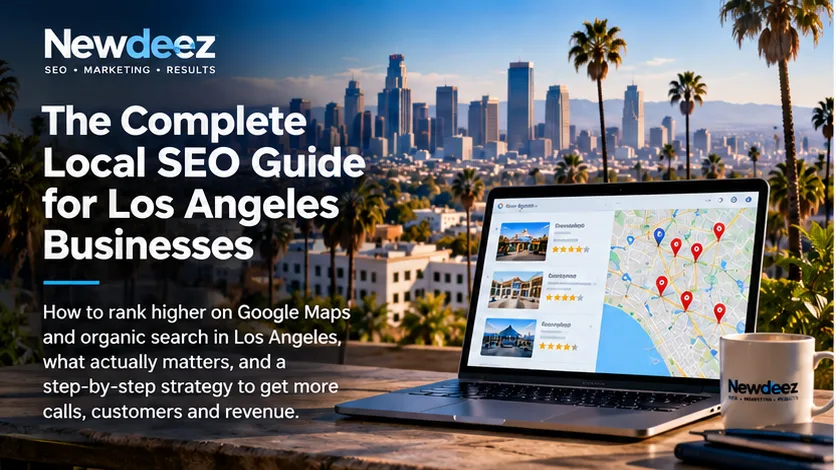
Local SEO is not one setting inside a Google Business Profile. It is the combined effect of accurate business information, relevant service pages, an accessible website, local prominence, and a frictionless path to contacting the business.
For a business competing in a crowded search market, the goal is not to check boxes mechanically. The goal is to identify the pages, signals and experiences that prevent qualified customers from finding and choosing the company. The following framework helps prioritize work that can be measured and maintained.
1. Confirm the business foundation
Check the actual public-facing name, address, phone number, primary category, hours, appointment links, website URL and eligible service areas. A profile should reflect how the business really operates, not an invented keyword-stuffed name. Record the current values before changing them.
2. Audit the Google Business Profile
Review ownership and access, category relevance, holiday hours, services, photos, attributes and the destination URL. Confirm there are no accidental duplicates or unapproved changes. If the business operates from a staffed, customer-facing location, verify the address is represented appropriately.
3. Map visibility from multiple search points
A search performed in Downtown Los Angeles does not necessarily return the same local results as one in Santa Monica. Use a consistent geo-grid, query set, device and observation date. Record where visibility is strong and where it falls off rather than relying on one screenshot.
4. Audit service-page intent
Give important services a clear page with scope, who the service is for, proof, FAQs and a conversion action. Avoid putting every service on a single thin page. Ensure page titles and headings describe what a customer can actually purchase.
5. Inspect location-page authenticity
Only build location pages where there is genuine operational relevance. Each should have unique local context, service availability, directions or service boundaries, examples and customer support information. Changing only the city name is not a strategy.
6. Review crawlability and indexation
Check status codes, robots directives, XML sitemap inclusion, canonicals and noindex tags. Search Console can reveal whether priority URLs are indexed and which queries generate impressions. Do not mistake a page being publicly accessible for proof that Google indexed it.
7. Strengthen local proof
Feature authentic reviews, named staff where appropriate, real photos, projects, licenses and verifiable testimonials. Include review request processes that comply with platform rules. Trust is particularly important when multiple providers offer similar services.
8. Improve conversion tracking
Measure calls, submitted forms, booked appointments and qualified leads, with privacy-aware analytics. Use consistent tracking definitions and compare performance by landing page and location. A Maps position is not itself a business outcome.
9. Check authority and consistency
Review important local citations, relevant industry directories, community mentions and earned editorial links. Correct inconsistent contact details. Avoid buying bulk low-quality links or generating doorway pages.
10. Prioritize and retest
Classify findings as blocking, high-impact or cosmetic. Fix indexing and contact failures first; then improve commercial relevance, proof and authority. Recheck the same keyword/location combinations after meaningful changes.
Frequently asked questions
Will this guarantee number-one rankings?
No. Search results vary by competition, location, intent and search-engine decisions. The purpose is to improve relevance, technical health, authority and measurable business outcomes.
How quickly should results be evaluated?
Fixes can be validated immediately, while organic performance should be compared across consistent multi-week and multi-month periods. Avoid interpreting one-day fluctuations as trends.
What should be measured first?
Track the highest-value commercial pages and queries, qualified calls or forms, and any indexing or usability failures. Then expand measurement to supporting content.
Next steps
Newdeez helps businesses connect technical SEO, commercial content, local visibility and measurable growth. Explore the relevant service: Local SEO services. Request a free competitive review to identify the highest-impact opportunities for your website.
