
How to Measure SEO Leads and Revenue Without Being Misled by Rankings
Published November 5, 2026 by Newdeez
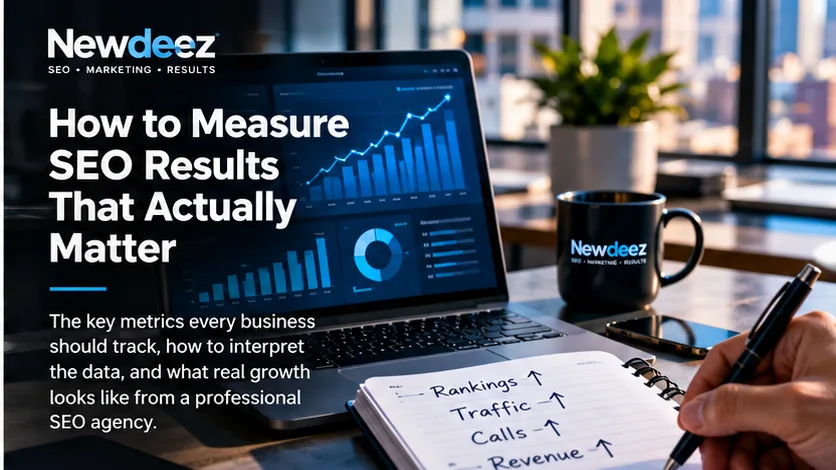
A business can rank for hundreds of keywords and still fail to grow. Conversely, a small number of commercially valuable queries can produce meaningful inquiries. That is why SEO reporting must connect visibility to real customer actions.
For a business competing in a crowded search market, the goal is not to check boxes mechanically. The goal is to identify the pages, signals and experiences that prevent qualified customers from finding and choosing the company. The following framework helps prioritize work that can be measured and maintained.
1. Separate leading indicators from outcomes
Impressions, indexed pages, click-through rate and keyword positions indicate visibility. Calls, form submissions, qualified opportunities, appointments and closed revenue indicate commercial results. Track both, but do not present one as a substitute for the other.
2. Establish a measurement baseline
Before implementation, export at least three months of Search Console data and the corresponding analytics period. Record brand and nonbrand clicks, priority landing pages, form completions, tracked calls and CRM outcomes. Annotate promotions and site changes that can distort comparisons.
3. Configure form tracking correctly
Fire conversion events on successful submissions, not merely button clicks. Test each form on mobile and desktop, verify thank-you-page or server-side confirmation, and deduplicate repeat events. Exclude spam and test leads from reporting.
4. Measure phone calls carefully
Use call tracking where appropriate and legally permitted. Document attribution rules, call duration thresholds and how qualified calls are identified. Ensure number insertion does not create inconsistent business information in crawlable page content.
5. Connect leads to business value
A CRM can distinguish inquiry, qualified lead, booked appointment, sale and revenue. The agency should not claim every call is a new customer. For service businesses, show cost per qualified opportunity and the rate at which leads become jobs.
6. Interpret attribution limitations
Consent settings, ad blockers, cross-device behavior and offline conversations can prevent perfect source matching. Organic search may assist conversions without receiving last-click credit. Use consistent methods and explain what is not measurable.
7. Segment by page and search intent
A service page attracting ready-to-buy visitors should be evaluated differently from an educational guide. Compare nonbrand organic landing pages, location, service category and device. High traffic to an unrelated article is not necessarily progress.
8. Read Search Console averages cautiously
Average position can shift because the set of queries changes. Evaluate a fixed group of high-value queries, impressions, clicks and actual landing pages. Search Console does not supply an exact, universal ranking for every location.
9. Build an executive dashboard
Include organic leads, qualified leads, bookings, revenue when available, nonbrand clicks, top commercial landing pages, local visibility, work completed and next actions. State date ranges and data sources clearly.
10. Use measurement to prioritize
If a page ranks but fails to convert, investigate intent, offer and usability. If it converts but lacks impressions, invest in relevance and authority. If leads are strong but sales are weak, examine qualification and follow-up before blaming rankings.
Frequently asked questions
Will this guarantee number-one rankings?
No. Search results vary by competition, location, intent and search-engine decisions. The purpose is to improve relevance, technical health, authority and measurable business outcomes.
How quickly should results be evaluated?
Fixes can be validated immediately, while organic performance should be compared across consistent multi-week and multi-month periods. Avoid interpreting one-day fluctuations as trends.
What should be measured first?
Track the highest-value commercial pages and queries, qualified calls or forms, and any indexing or usability failures. Then expand measurement to supporting content.
Next steps
Newdeez helps businesses connect technical SEO, commercial content, local visibility and measurable growth. Explore the relevant service: Search engine optimization services. Request a free competitive review to identify the highest-impact opportunities for your website.
