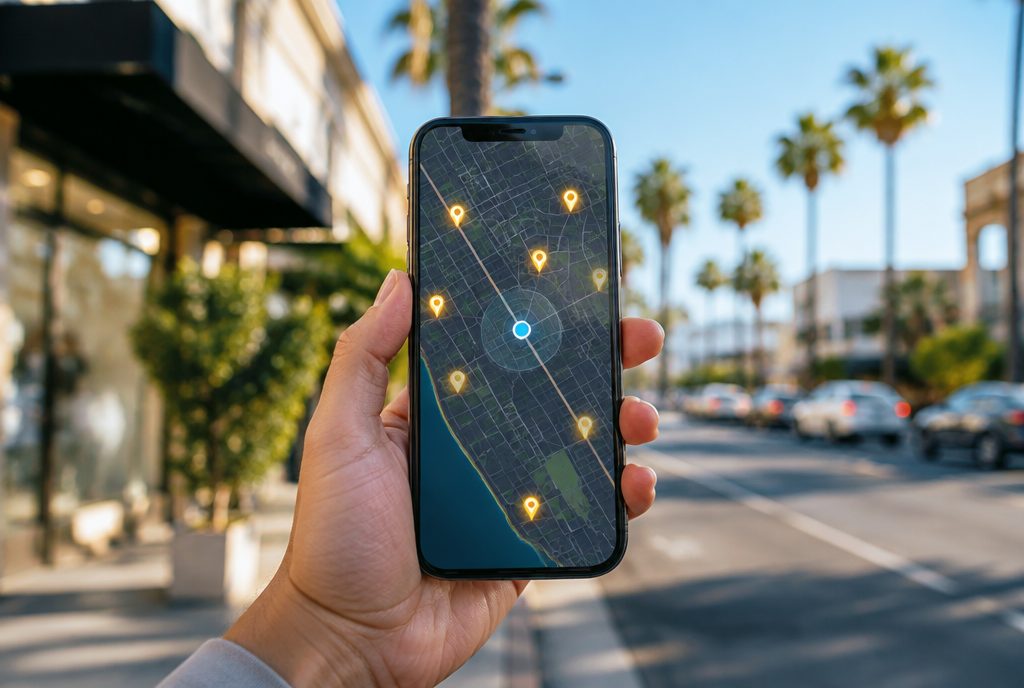
The ranking factors that move results in Los Angeles are the same ones Google documents everywhere: for map results, relevance, distance and prominence; for organic results, helpful content that matches the search, a site Google can crawl and index, a good page experience and links from trusted sites. What makes LA different is how hard each factor is contested. Dense competition, neighborhood-level intent, searches in several languages and competitors with years of head start mean small gaps decide who ranks.
- Local map rankings and organic rankings run on different systems. Diagnose which one you are losing before you change anything.
- Google publicly documents its main signals. Focus on those instead of chasing rumors or tricks.
- In LA, the bar is set by your actual competitors in your actual neighborhood, so study them closely.
Two different rankings on one results page
A typical local search in Los Angeles, such as “family lawyer near me” or “sushi Sawtelle,” returns two separate sets of results:
- The local pack: the map and three business listings, drawn from Google Business Profiles.
- Organic results: the web pages listed below, ranked from Google’s index of websites.
These are related but not the same. A business can sit in the top three on the map while its website is on page two, or the reverse. Your website does influence map rankings, and your reviews and profile can earn organic clicks, but the main levers differ. That is why the first step in any ranking problem is figuring out which list you are trying to move.
If you are new to the overall process, our Los Angeles SEO guide covers the full plan, and our local SEO guide for Los Angeles businesses walks through the map side step by step.
Local ranking factors: relevance, distance and prominence
Google’s own help article on improving your local ranking names three main factors.
Relevance
Relevance is how well your Business Profile matches the search. Your primary and secondary categories, the services you list, your business description and the content of your website all contribute. A dentist whose profile lists “cosmetic dentistry” and links to a strong cosmetic dentistry page has a clearer relevance signal than one with a generic profile.
Distance
Distance is how far the business is from the searcher, or from the location in the search. You cannot change it without moving, which is why the same search can show completely different businesses in Westwood and in Culver City. Accept distance as a constraint and compete hard on the other two factors.
Prominence
Prominence is how well known your business is. Google says this includes how many websites link to you and how many reviews you have, and that more reviews and positive ratings can help local ranking. Since links pointing to your website are part of prominence, website SEO and local SEO are hard to separate. Google also says businesses with complete and accurate information are more likely to show up in local results.
Google is explicit that you cannot pay for a better local ranking. Google Ads can place an ad above the map, but it does not change your organic position. We explain how the two channels fit together in SEO vs Google Ads for Los Angeles businesses.

Organic ranking factors Google documents
Google uses many signals for organic rankings and does not publish weights, but its documentation is clear about what it rewards.
Helpful, reliable content
Google’s guidance asks whether content is written for people first, shows real experience and expertise, and provides substantial value compared with other pages in the results. For a local business, that means service pages that genuinely explain the service, proof of work, honest pricing context and answers to the questions customers actually ask.
Relevance to the query
Google looks at whether a page contains the information the searcher wants, including the words they use. That is not keyword stuffing. It means a page about “ADU construction in Los Angeles” should clearly cover ADUs, the process, local permitting and timelines, rather than a vague overview of construction.
Crawling and indexing
A page Google cannot crawl or chooses not to index cannot rank at all. Broken internal links, accidental noindex tags, duplicate pages and heavy JavaScript that hides content are common problems on LA business websites, especially after redesigns. Our technical SEO services focus on exactly these issues.
Page experience
Google says its ranking systems reward content that provides a good page experience, including Core Web Vitals (loading, responsiveness and visual stability), mobile friendliness, HTTPS and avoiding intrusive interstitials. It also says there is no single page experience signal and that relevant, helpful content can still rank even when page experience is not perfect. Treat speed and usability as important tie-breakers and conversion boosters, not as a substitute for good content.
Links
Links from other sites help Google discover pages and serve as a signal of relevance and trust. The quality and relevance of the linking site matter far more than the count. Manipulative links, such as paid links meant to pass ranking value, violate Google’s spam policies. Our link building services focus on earning links from real publications, partners and local organizations.
Which factors are holding your business back?
We will compare your website and Google Business Profile against the businesses ranking above you in your part of LA and show you the gaps that matter most.
Get my free ranking review →LA-specific realities that shape rankings
The factors are universal. The way they play out in Los Angeles is not.
Density
Many categories have dozens of competitors within a short drive. When businesses are packed closely together, the distance advantage shrinks and relevance and prominence decide more of the outcome. A thin profile or a handful of old reviews is a much bigger handicap here than in a small town.
Neighborhood intent
Angelenos often search by neighborhood or nearby city: “Silver Lake coffee,” “Santa Monica personal trainer,” “Koreatown dentist.” Some of those places are neighborhoods of the City of Los Angeles and some are separate cities in the county. Pages and profiles that clearly connect your business to the areas you serve, with genuine local detail, give Google more to work with than a single page that says “serving all of Los Angeles.”
Multilingual searches
Los Angeles customers search in Spanish, Korean, Armenian, Chinese, Tagalog and many other languages. If you serve customers in another language, a properly translated version of your key pages (not a machine-translated copy) can make you relevant to searches your English-only competitors never reach. Use separate URLs for each language and hreflang annotations so Google shows the right version, and mention the languages you speak on your Business Profile and website.
Competitor depth
In categories like law, medicine, real estate and home services, the businesses ranking above you may have years of content, strong backlink profiles and large review counts. You will not close that gap in one move. The realistic path is to find the specific services, neighborhoods and search terms where the competition is weakest, win those first, and build authority outward.
What does not move rankings (or backfires)
- Keyword-stuffed business names. Adding “Best LA Plumber” to your profile name may seem to help briefly, but it violates Google’s guidelines and risks suspension.
- Buying reviews or links. Both break Google’s policies. The risk outweighs any short-term gain.
- Meta keywords. Google has said for years that it does not use the meta keywords tag for ranking.
- Word count for its own sake. Longer is not better. Complete and useful is better.
- Copy-and-paste city pages. Dozens of near-identical location pages are treated as doorway pages and rarely hold rankings.
- Schema as a ranking shortcut. Structured data helps Google understand your pages and can make them eligible for rich results, but it is not a direct ranking boost on its own.
How to prioritize your next move
Work through these questions in order:
- Can Google crawl and index your important pages? If not, fix that first. Nothing else matters until it is solved.
- Which results are you missing? Map results, organic results or both. Check from several locations in your service area.
- Who is ranking instead? Compare their categories, reviews, service pages, location pages and links with yours.
- Where is the biggest, most fixable gap? Often it is a missing service page, a weak primary category or a review gap, not a mysterious algorithm issue.
- Is the work measured by leads? Track calls, forms and bookings so you know which changes actually paid off.
If your map rankings are the problem, our guide on why a business isn’t ranking on Google Maps covers the common causes. For broader visibility work, see our local SEO services in Los Angeles or talk to our Los Angeles SEO company about a full plan.
Frequently asked questions
What is the biggest ranking factor for local SEO in Los Angeles?
Google names relevance, distance and prominence as the main local factors. Distance is fixed, so the businesses that win usually have the most accurate categories, the strongest service pages and a steady stream of genuine reviews.
Do Core Web Vitals affect rankings?
Google says its ranking systems reward a good page experience, which includes Core Web Vitals. It also says helpful, relevant content can rank even when page experience is not perfect, so treat speed as an important supporting factor rather than the main one.
Does running Google Ads improve organic rankings?
No. Google states you cannot pay for better local rankings, and ads do not change organic positions. Ads and SEO can work well together, but they are separate systems.
Should I create pages in Spanish or other languages?
If you genuinely serve customers in that language, yes. Use properly translated pages on separate URLs with hreflang annotations, and make sure someone on your team can actually help those customers.
Why do my rankings change from one neighborhood to the next?
Local results depend partly on the searcher’s location, so the same search can show different businesses a few miles apart. Check rankings from several points across your service area instead of relying on a single search from your office.